From Benchmarks to Training Goals: How to Build the Best Hockey Microcycle
Field Hockey Microcycle: Training-to-Match Targets
In elite hockey, the match is 100%. We use position-specific benchmarks (men & women) and simple Training-to-Match ratios to turn that benchmark into clear daily targets. Plus a Live App workflow to check if you're on track.
Introduction
In elite hockey, the match is the reference point. We use position-specific benchmarks (men & women; CDEF, FULL, MID, WIN, STR) as 100% and express every training day as a Training-to-Match (T:M) ratio. This keeps planning simple, comparable across positions, and fully aligned with sports science.
Why Training-to-Match (T:M)?
Research by Gabbett, Buchheit, and the Verheijen-school shows that teams benefit from (1) the hardest load early in the week, (2) at least two speed exposures above 90–95% Vmax, and (3) a taper towards match day. T:M makes that actionable: you take the positional match benchmark and multiply it by the daily ratio.
How to use it
Pick the match benchmark for the position (e.g., women’s winger sprint distance per match).
Multiply by the daily ratio in the table below.
Example: if a winger sprints 280 m in a match, then MD-4 (main) ≈ 60–70% → 170–200 m, MD-4 PM (speed) ≈ 30% → ≈85 m, MD-2 (prep) ≈ 20% → ≈55 m.
Keep RPE as the simple internal-load check per session.
Weekly Session Targets (training only)
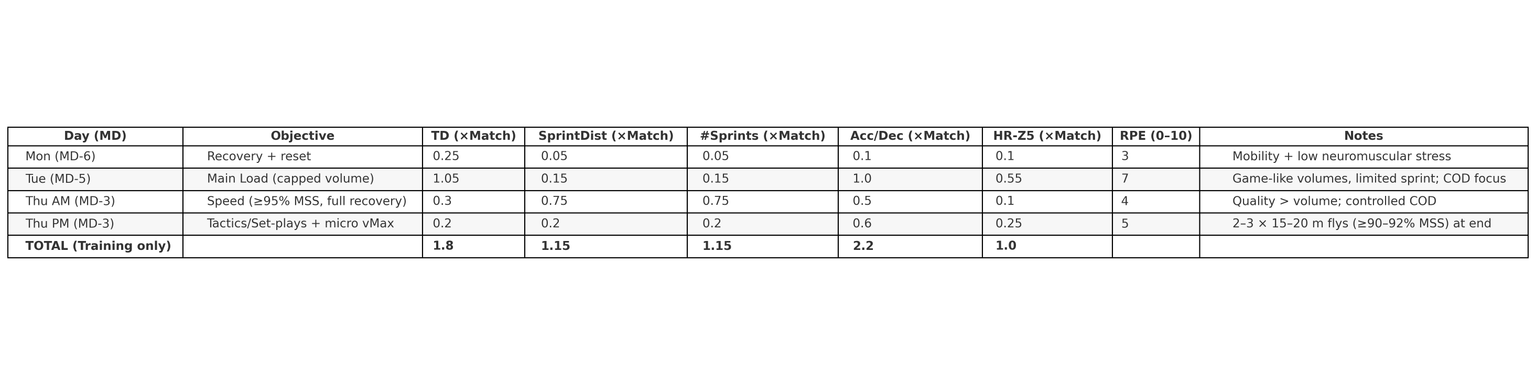
With the ratios below you typically land on TD ≈ 1.8×, sprint ≈ 1.15×, high acc/dec ≈ 2.20×, HR-Z5 ≈ 1.0× of match load—high enough to develop, conservative enough to protect availability.
Example: Sunday to Sunday Targets
Sunday to Sunday Table: Field hockey microcyle-Saturday match daily training targets (T:M%)
Note: SD and #Sprints are expressed as a percentage of the position-specific sprint benchmark, not of total distance. Use your own men’s/women’s benchmarks as the 100% reference.
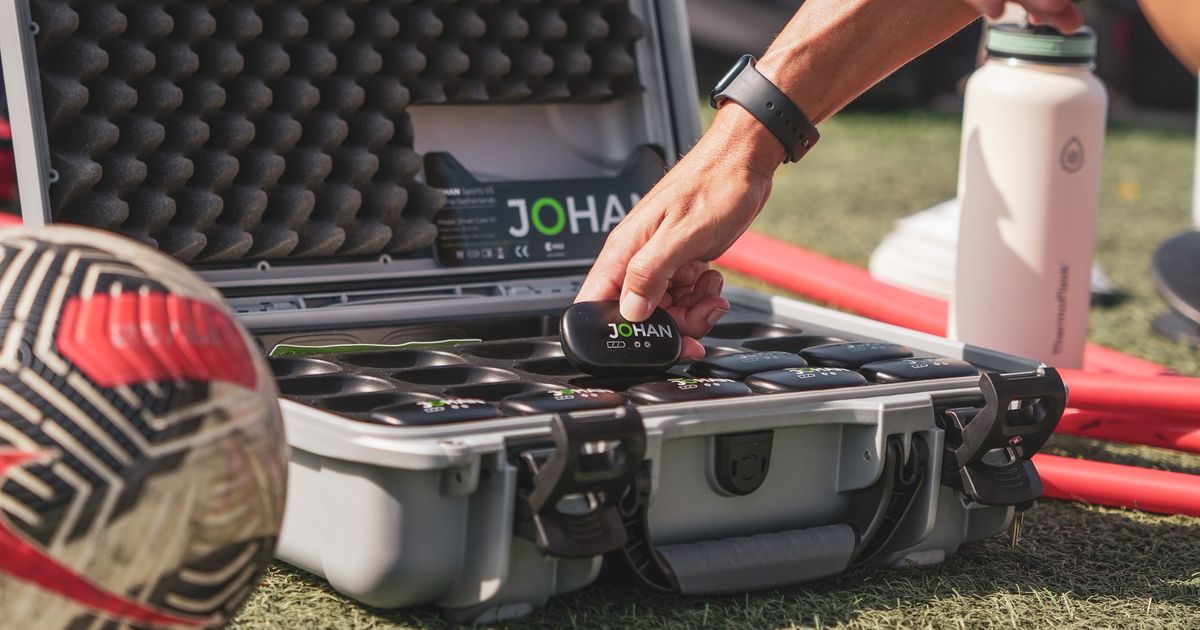
Fill the targets in the Johan Sports Live app (so coaches can see if they’re on-track)
For a step-by-step walkthrough of creating team / group / individual targets in the Johan Sports Live App, see our companion article: Live App Targets It shows exactly how to set targets for TD, RD, SD, #Sprints, High Acc/Dec, HR-Z5 and RPE, and how the live view flags on pace / under / over so you can adjust in real time.
Gabbett, T.J. The training–injury prevention paradox: should athletes be training smarter and harder? Br J Sports Med (2016).
Buchheit, M., Laursen, P.B. High-Intensity Interval Training, solutions to the programming puzzle (Parts I & II). Sports Medicine (2013).
Miguel, M. et al. Daily and weekly external loads in the microcycle based on match reference values. Frontiers in Sports & Active Living (2022).
Fernández, D. et al. Integrating External and Internal Load for Monitoring Fitness and Fatigue during a standard microcycle. Frontiers in Physiology (2021).